
Solutions | Digital Transformation
We transform the way work gets done.
AI has enormous potential. Turning that potential into meaningful change is the challenge. We provide transformation consulting & training services, that deliver results and optimse worflows.
We care about your data in our privacy policy.
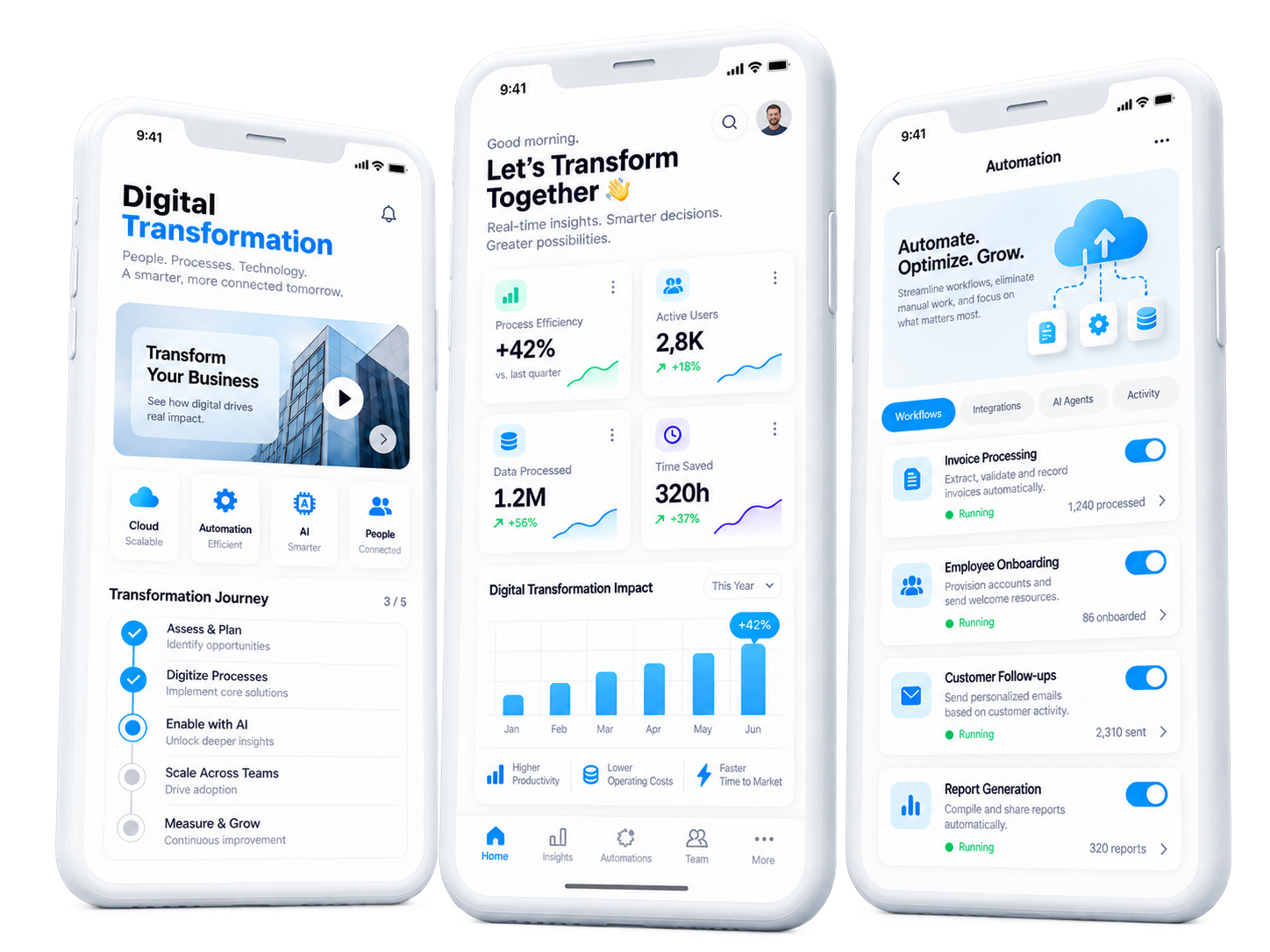
Transform How Work Gets Done.
We identify inefficient, repetitive and fragmented ways of working and redesign them around AI, automation and smarter processes.
Turn AI Adoption Into Capability.
Technology alone doesn’t create transformation. We equip your people with practical skills, role-specific use cases and the confidence to make AI part of everyday work.
Deliver Measurable Business Results.
We connect AI initiatives to meaningful business outcomes — from time saved and productivity gains to improved processes and better decision-making.
Build AI Confidence & Readiness.
We help prepare your organisation for AI by developing the skills, governance, mindset and foundations required for responsible, sustainable adoption.
Transform. Enable. Optimise.
We help organisations turn AI ambition into measurable business impact through transformation consulting, workflow optimisation and practical AI enablement.
Our Approach.
We find the right AI opportunities, redesign how work gets done, enable your people, and measure what delivers real business value.
Smarter workflows. Empowered people. Measurable impact.
A Practical Path to AI Transformation - Discover - Identify - Prioritise - Design- Enable -Implement - Measure - Scale.
Frequently Asked Questions
What is AI readiness?
AI readiness is an organisation’s ability to adopt and use artificial intelligence effectively, responsibly, and at scale. It includes having the right strategy, governance, data practices, tools, skills, workflows, and internal capability in place.
How do I know if my business is ready for AI?
A business is AI-ready when it has clear use cases, suitable data and systems, defined governance, employees who understand how to use AI, and processes where AI can create measurable value. An AI readiness assessment can help identify gaps and priorities.
What does an AI readiness assessment include?
An AI readiness assessment typically reviews business objectives, existing workflows, data and technology, employee capability, governance requirements, current AI usage, and potential use cases. The goal is to identify practical opportunities and create a clear adoption roadmap.
How can AI improve existing business workflows?
AI can help automate repetitive tasks, improve decision-making, accelerate research and content creation, support customer service, improve reporting, and reduce manual administration. The best opportunities are usually found by reviewing existing workflows and identifying areas where AI can save time or improve consistency.
What is responsible AI governance?
Responsible AI governance refers to the policies, controls, and processes that guide how AI is used within an organisation. This can include data privacy, security, accountability, human oversight, acceptable use, risk management, and the responsible handling of AI-generated outputs.
Do employees need AI training?
Yes. AI tools are most effective when employees understand how to use them correctly. Practical training can help teams write better prompts, evaluate AI outputs, recognise limitations and risks, and apply AI effectively to their everyday work.
How do you choose the right AI tools for a business?
AI tools should be evaluated based on business requirements, functionality, usability, integration capability, security, data privacy, cost, scalability, and risk. The goal is to select tools that solve real business problems rather than adopt AI technology for its own sake.
Can AI be integrated into existing systems and processes?
Yes. AI can often be integrated into existing workflows, platforms, and business processes through APIs, automation tools, AI assistants, and purpose-built integrations. The approach depends on the systems already in use and the business outcome being targeted.
How long does AI implementation take?
The timeline depends on the complexity of the use case, the organisation’s current level of readiness, and the systems involved. Some workflow improvements can be implemented quickly, while broader AI transformation programmes may be delivered in phases over several months.
How does ByteKast help organisations adopt AI?
ByteKast helps organisations assess AI readiness, identify high-value opportunities, establish responsible AI practices, evaluate tools, train teams, integrate AI into workflows, and continuously improve adoption and performance.